If you run a small business, you probably already feel it: marketing in 2026 is a completely different game. And that’s why you need a comprehensive small business marketing guide to guide you through it.
Here’s the truth: Customer behavior has shifted. AI has changed how we create content. Paid ads are more expensive than ever. Organic reach is harder, but more valuable.
And competition? It’s everywhere.
When I first started consulting for small businesses years ago, you could get by with a simple website, a Facebook page, and a few well-written blogs. But today, small business marketing requires a hybrid approach: a smart content strategy, email marketing, a consistent social media presence, and a suite of AI-powered optimization tools that actually work.
So, in this guide, I’m breaking down the complete small business marketing playbook for 2026, which includes everything I’ve tested and everything I’ve learned from ranking thousands of keywords across multiple industries.
Let’s get into it.
What Is Small Business Marketing?
Small business marketing is the process of promoting your products or services to attract customers, build brand awareness, and generate revenue, but with smaller budgets, smaller teams, and much tighter priorities.
Unlike big brands, small businesses must focus on:
- Smart automation
- Niche authority-building
- Low-cost customer acquisition
- Tools that save time, not just money
- High ROI channels (like SEO and email)
And with AI accelerating content production everywhere, quality has officially become more important than quantity.
One of the biggest shifts in 2026 is this: small businesses no longer win by creating more content; they win by creating the right, evergreen content.
The 2026 Marketing Framework for Small Businesses (My Proven System)
Over the past few years, I’ve used the same 5-stage framework to help small businesses grow and now I’m sharing it with you.
Here’s the framework I still use in 2026:
1. Build a Strong Online Foundation
Before running ads or creating content, you need to build a strong online foundation for your business.
This usually includes:
- A fast, mobile-optimized website
- Clear product/service pages
- Location pages (for local businesses)
- Strong internal linking
- A clean site architecture
Then comes SEO, which is the part most small businesses skip because it feels technical. However, that’s not true. It’s the most fundamental aspect of creating a solid online presence.
If you’re new to it or feel that you lack the skills to do it on your own, you can use SEO tools like All In One SEO, especially if your website is built in WordPress.
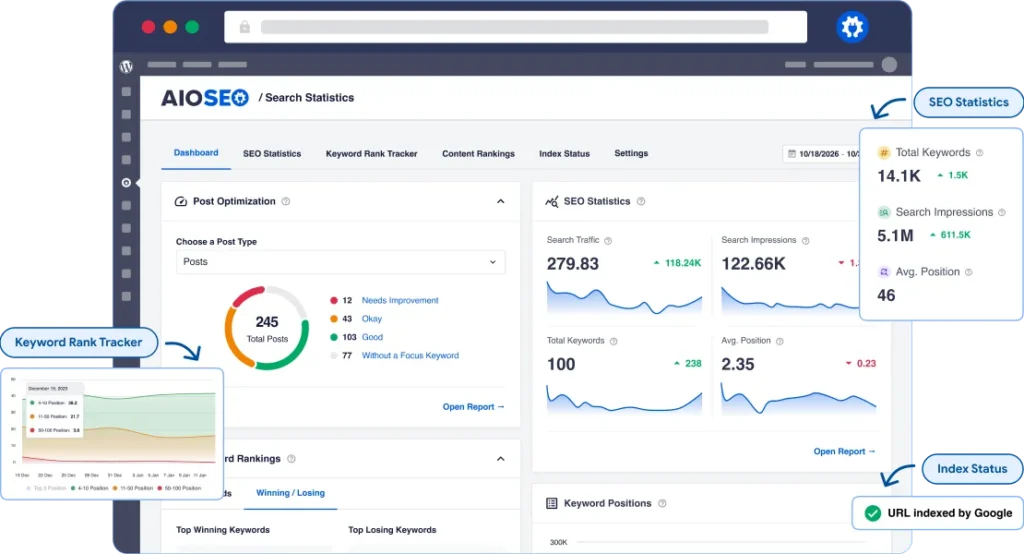
AIOSEO really covers the basics for you and help you with:
- TruSEO on-page optimization
- Schema markup
- Local SEO settings
- Sitemaps
- Redirects
- Link Assistant
This way, you can focus on marketing your business while the plugin handles your SEO needs.
2. Create Helpful, Search-Focused Content
In 2026, content is still king, but only if it’s aligned with search intent.
Search intent is perhaps one of the most important factors to consider when creating content. It helps you understand what your buyers are searching for and how you can help them.
Now, broadly speaking, there are four types of content every small business needs. This includes educational, conversion-focused, authority, and local content.
They all serve different purposes and have different content formats. You can prioritize one over the other based on your business’s specific needs.
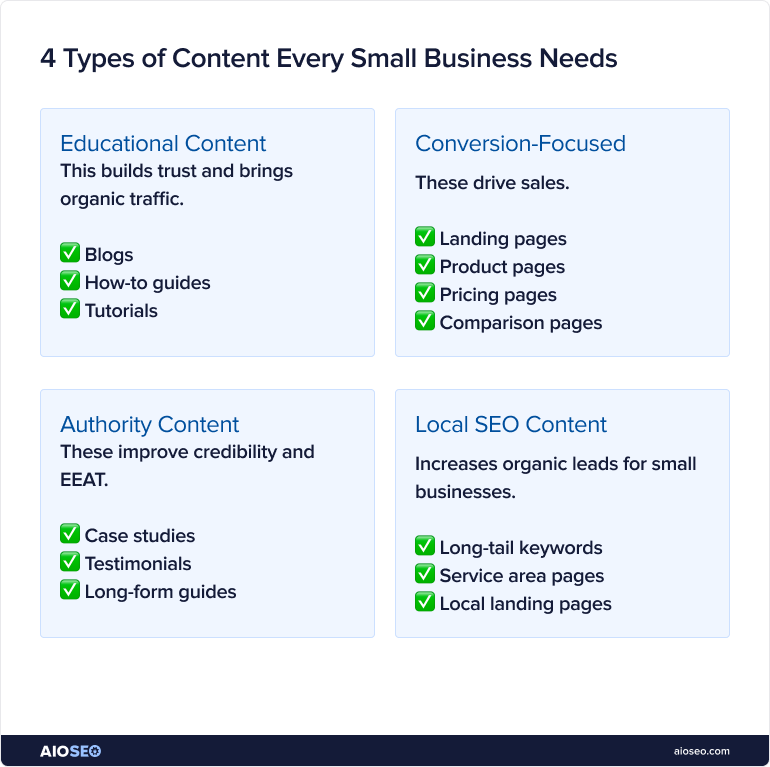
For instance, educational content builds long-term trust with the audience and brings in organic traffic. It’s usually in the form of blogs, how-to guides, and tutorials.
If you want more conversions, which most businesses do, obviously, you should create more conversion-focused content, which would mean creating targeted landing pages, optimizing your product and pricing pages.
I also recommend creating comparison pages to highlight your product’s benefits compared to competitors’. These pages are a great opportunity to highlight why and how your product solves the problem more effectively, and they drive sales, too.
Authority content usually goes hand in hand with educational content, as the two overlap in the form of long-form guides. But you can also share case studies and testimonials from existing customers to strengthen your credibility.
And if your business can benefit from a local customer base, I’d also advise targeting local keywords to build organic leads around your area.
If you want to create a pool of these keywords, you can use SEOBoost’s Topic Reports feature, which makes this 10x easier by outlining 7 different types of reports for each keyword you need to target.

These reports cover:
- Subtopics Google expects
- Word count
- Competitor analysis
- Questions to include
- Secondary keywords
It’s like a cheat code for building content that ranks faster.
3. Use AI to Scale, Without Losing Quality
Let me tell you something, which I know a lot of small business owners can worry about: AI isn’t here to replace marketers; it’s here to help small businesses move faster.
And here are some of the best AI content optimization tools I recommend in 2026:
1. SEOBoost
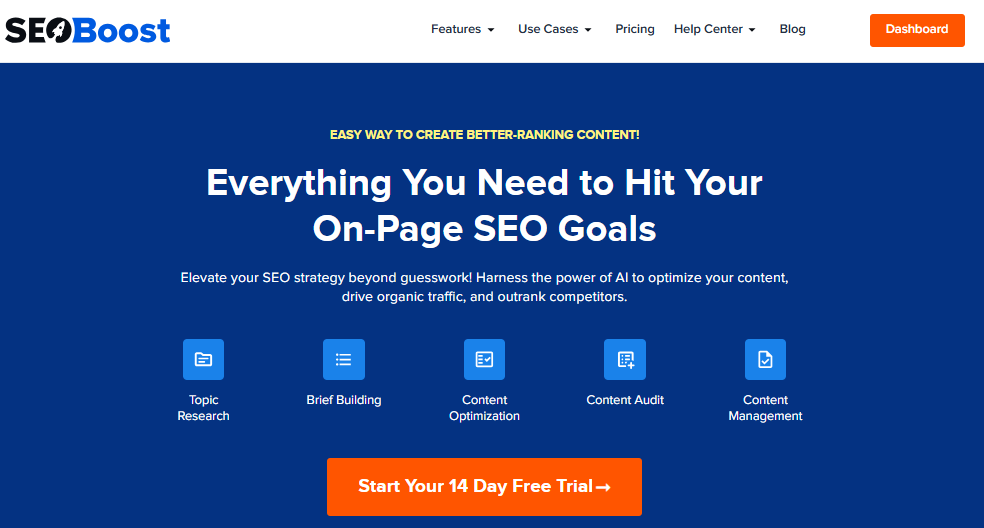
SEOBoost is my go-to content optimization tool powered by AI. For small businesses, it really helps with content ideation and optimization to ensure the content you put out captures your audience’s attention. Instead of hiring an SEO consultant for research, you generate structured briefs instantly and publish optimized posts consistently.
It simplifies the following processes for you:
- Topic research based on live SERP data
- AI-powered content briefs for writers
- Real-time content optimization
- Content audits to fix ranking drops
- Content scoring before publishing
Instead of guessing what to write or how long a blog should be, SEOBoost tells you exactly what Google expects. That means fewer rewrites, faster drafting, and better potential for ranking.
2. All In One SEO
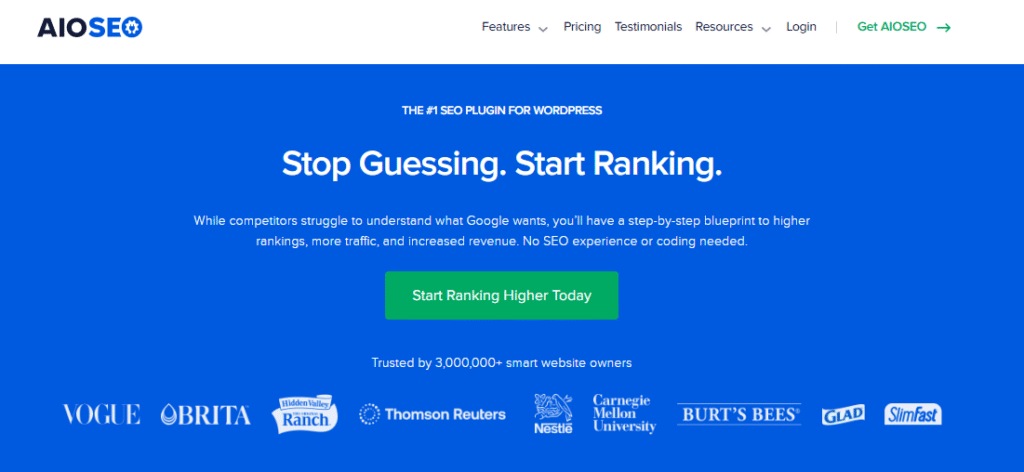
If your small business website runs on WordPress, AIOSEO simplifies the technical side of SEO. It handles the behind-the-scenes optimization that many business owners ignore, but that Google absolutely evaluates.
More importantly, as a small business owner, it saves you money as you don’t need a developer to implement structured data or fix SEO basics.
Here are some of the awesome SEO tasks it covers:
- Schema markup (structured data)
- XML sitemaps
- Redirect management
- On-page optimization guidance
- Local SEO settings
- Built-in AI writing assistant
Instead of worrying about broken links, indexing issues, or missing metadata, AIOSEO handles them all in your WordPress dashboard.
3. LowFruits
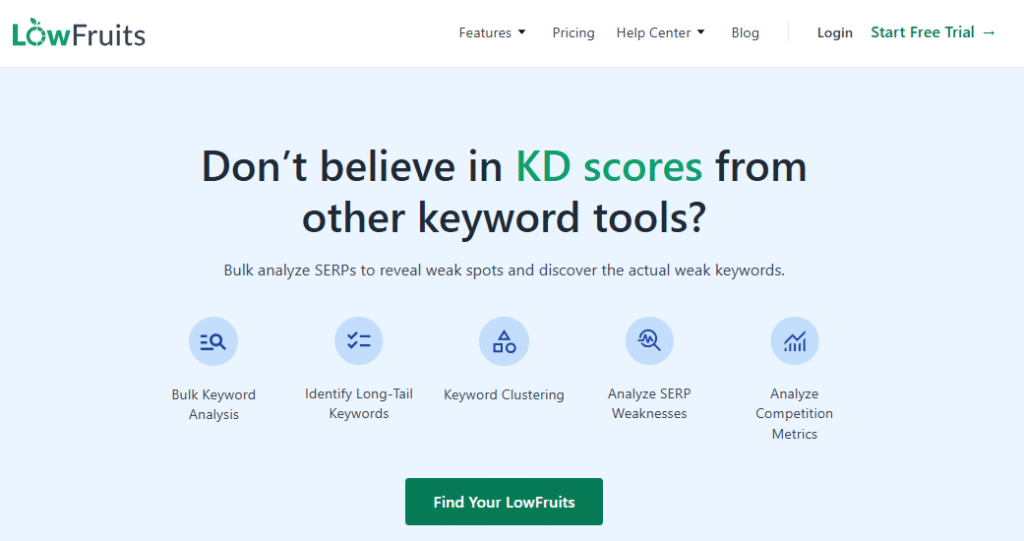
LowFruits is especially powerful for small businesses because it focuses on finding keywords with weak competition. Instead of trying to rank for massive head terms, you target long-tail opportunities that bigger brands overlook.
You can find realistic ranking opportunities and publish content that gains traction faster. This is especially useful for local businesses or niche service providers.
Here’s what it helps you with:
- Keyword discovery
- Long-tail keyword clusters
- Spotting weak competitor pages
- Identifying low-competition SERPs
This approach allows smaller sites to compete intelligently instead of aggressively.
4. Build a Multi-Channel Presence
Small businesses don’t need to be everywhere, but they need to be visible where it matters.
And that’s why you need to have a multi-channel presence strategy. Some of the non-negotiable channels that I recommend include creating content for Google Search (SEO and Local SEO), email marketing, and creating a Google Business Profile.
Apart from these, depending on your business niche, I’d also recommend creating a social media presence on:
- TikTok
- Pinterest (for e-commerce)
- YouTube (for service businesses)
In my opinion, short-form content still dominates, but SEO remains the highest-ROI channel across all small-business categories.
5. Track What Matters (And Ignore Vanity Metrics)
Small businesses don’t need dashboards with 40 KPIs. If you get stuck on chasing vanity metrics, you might not be able to make any real progress with your digital growth.
So, here are the 5 metrics that I suggest following:
- Organic traffic
- Leads or inquiries
- Search rankings for target keywords
- Email list growth
- Cost per acquisition
These ensure you stay aligned with your growth strategy and can easily spot changes.
The Best Small Business Marketing Strategies for 2026
More than anything else, small business marketing in 2026 is about doing the right things exceptionally well. After working with dozens of small businesses across SaaS, retail, home services, wellness, and local industries, these are the core strategies I’ve seen consistently generate growth.
1. Strengthen Your SEO Foundation
Search is still where customers begin their buying journey, and in 2026, Google is prioritizing high-quality, deeply relevant content more than ever. That means small businesses can’t afford to ignore SEO anymore.
A fast website, optimized pages, clear navigation, and structured data all help Google understand what you do — and who you serve.
This is one of the reasons why I recommend SEO tools like AIOSEO so much, because they really make this easy by handling metadata, schema, sitemaps, redirects, and local settings without needing technical knowledge.
Once the foundation is strong, you can start building content. You can also use content optimization tools to make this stage easier.
2. Publish High-Quality, Search-Aligned Content
The internet is flooded with AI-generated content, but very little of it is actually helpful.
Remember, Google’s ranking systems now reward topical depth, accuracy, and originality, all of which small businesses can deliver with the right framework.
So, make sure that you match the search intent with the type of content you produce.
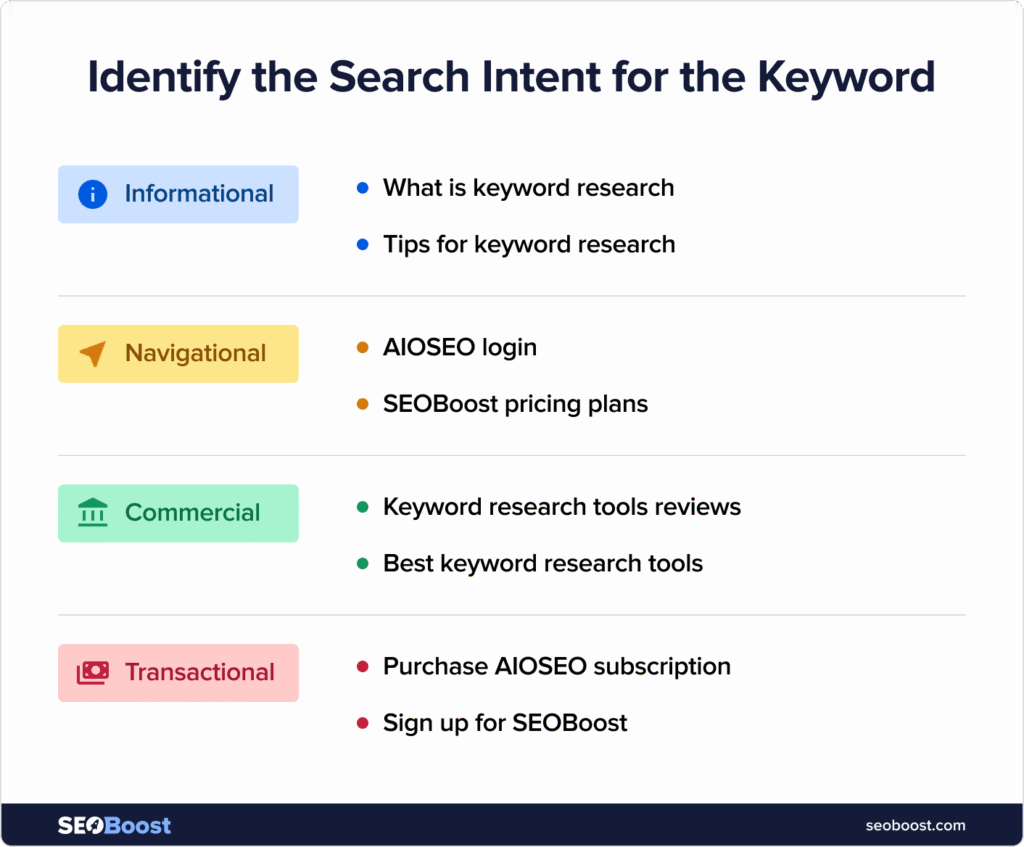
Apart from nailing keyword intent, I’d advise you to focus on three types of content: blog posts answering customer questions, comparison pages, and long-form guides.
That’s because these content types will help you build your authority and naturally place the importance of your product.
3. Invest in Local SEO
Local search continues to dominate small business discovery. Whether you’re a dentist, restaurant, consultant, boutique, trainer, or home services provider, your Google Business Profile (GBP) is now just as important as your website.
Optimizing GBP with consistent photos, weekly posts, updated services, and fresh customer reviews can dramatically increase calls and walk-ins.
Like I mentioned before, if your website is on WordPress, you can also use AIOSEO’s Local SEO feature.
It makes sure your business information, schema, and location signals are aligned across your site.
4. Use AI to Speed Up Your Marketing
AI tools are essential for small businesses in 2026, not because they replace humans but because they reduce workload.
I’ve mentioned the 3 essential AI tools you can start with. But if you want to expand beyond that, I’d recommend using other complementary tools like Jasper, Copy.ai, and Claude to help draft emails, captions, and ideas quickly, freeing you to focus on strategy.
But remember, where AI really shines is in SEO content and optimization. So I’d suggest pairing any AI writing tool you use with an optimization tool like SEOBoost to turn AI from a writing tool into a ranking system.
5. Build Trust With Proof-Based Marketing
One mistake many small businesses make is assuming their customers only want information and missing out on adding social proof.
Small businesses that showcase authentic stories outperform those that rely solely on promotional messaging.
This is why, you should add more case studies, testimonials, user-generated content, founder stories, and behind-the-scenes posts to build emotional credibility.
If you’re worried about where to start from, you can always start with just one strong customer story, which can outperform a dozen generic blog posts. That’s because it gets specific and builds trust with other potential buyers by showing how your product has made a difference.
So, make sure you use your website, GBP, social media, and email to highlight real results.
6. Focus on Email Marketing
Email remains the most profitable channel for small businesses, especially as social reach continues to shrink and ad costs rise. You don’t need complex funnels to succeed; you just need consistency and value.
I’d advise starting with sending one useful newsletter per week or fortnightly if you’re a really small team.
Once you start growing your email base, you can also add other automations, such as abandoned cart, welcome sequence, testimonial, and product launch automations.
Pro Tip: Pair email with SEO content to nurture visitors who aren’t ready to buy yet.
Again, you can always use AI tools for ideation, but I’d suggest drafting the emails yourself to create a personal connection with your subscribers.
7. Create Short-Form Videos
TikTok, Instagram Reels, and YouTube Shorts continue to dominate attention in 2026. But the goal for small businesses shouldn’t be going viral; rather, it should be to create a consistent brand presence.
Short-form videos build trust because they show your face, your process, your personality, and your expertise. They’re perfect for educating, demonstrating, storytelling, and answering frequently asked questions about your product or brand in an engaging way.
You can also use AI editing tools like CapCut to make video creation achievable even for small teams.
8. Refresh Old Content Regularly
Google now updates search results faster than ever.
And that means your older content can lose rankings more quickly, sometimes within 60-90 days. That’s why doing content updates should be a part of your quarterly strategy.
This would involve identifying content decay, and they’re part of the strategy.
Content decay is the gradual decline in a webpage’s search rankings and organic traffic over time due to outdated information, increased competition, or shifts in search intent.
You can use SEOBoost’s Content Audit feature to help you refresh content.
This feature shows exactly which pages are slipping and why. All you have to do is put in the URL of your existing content and the focus keyword you want to improve the ranking for. It generates a complete report of what’s missing and can be added to improve the position in search engines.

Instead of rewriting everything, you can then make targeted updates: improving subtopics, adding examples, refreshing statistics, and re-optimizing keywords.
This preserves organic traffic and keeps content competitive.
Final Word
Small business marketing in 2026 is defined by clarity, consistency, and smart use of tools.
The businesses that win aren’t the ones creating the most content; they’re the ones creating the most relevant content, optimizing their local presence, and building genuine trust through storytelling and proof.
Remember to use AI as your creative assistant, and you’ll grow faster than ever.
FAQs
What is the 3-3-3 rule in marketing?
The 3-3-3 rule in marketing is a simple framework that helps businesses stay focused and consistent by focusing on 3 target audiences, 3 core messages, and 3 primary marketing channels. It’s especially useful for small businesses with limited budgets because it forces clarity and prioritization.
What is the best marketing strategy for a small business?
The best marketing strategy for a small business is one that combines search visibility, trust-building, and consistent relationship nurturing. Small businesses often see the highest ROI from SEO and email marketing because they compound over time. Paid ads can support growth, but sustainable organic visibility tends to deliver more stable long-term results.
What are the 5 C’s of small business marketing?
The 5 C’s of small business marketing are Company, Customers, Competitors, Collaborators, and Climate. This framework helps businesses evaluate both internal strengths and external market conditions. Using the 5 C’s ensures that marketing decisions are strategic rather than reactive, especially for small businesses operating in competitive or changing environments.